THE NELSON SECTION OF THE WAHINE ANCHOR CHAIN
THE WAHINE CHAIN AT HIGGINS HERITAGE PARK
This piece of chain was previously used for crushing scrub in forestry development at Golden Downs and i”It’s a piece of history that wants to be preserved.”
In 1974 part of the salvaged anchor chain from the TEV Wahine which founded on Barretts Reef, Wellington, was brought to Golden Downs State Forest to crush Manuka and other scrub to prepare for a clean burn-off prior to planting pine trees.
The scrub clearing was achieved by using two 84 link lengths of chain, attached side by side between an Allis Chalmers HD16 crawler tractor and an International TD20 crawler tractor working 20 metres apart dragging the chain which crushed all the vegetation in its path.
The two drivers were in radio contact, and this method was most successful apart from the very steep hill tops where it was not used.
Other Wahine chain links can also be seen at the Richmond A&P Grounds, and Tapawera School.
T.E.V. (Turbo Electric Vessel) WAHINE
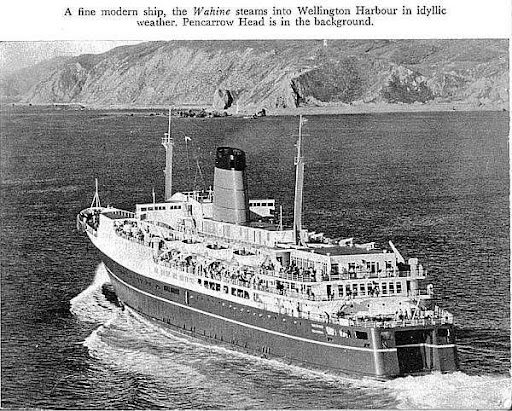
TEV Wahine was a twin screw, turbo-electric, roll-on / roll-off passenger ferry. It was built by the Fairfield Shipbuilding Company in Glasgow, Scotland for the Union Steam Ship Company NZ for their Wellington – Lyttelton Steamer Express Service. She arrived in Wellington on 24 July 1966 and sailed on her maiden voyage to Lyttelton one week later, on 1 August 1966
The Wahine was permitted to carry a maximum of 1,100 passengers on day trips, or 927 berthed passengers on overnight trips.
Wahine was 148.7 metres (488 ft) long, had a beam of 21.6 m (71 ft) and was 8,948 gross registered tons (GRT). At the time Wahine was the Union Company’s largest ship and one of the world’s largest passenger ferries. The powerplant was turbo electric transmission with four boilers supplying steam to two turbo alternators that drove the twin main propellers and gave a top speed of 22 knots (41 km/h). The ship also had stern and bow thruster propellers to propel her sideways for easier berthing. She had stabilisers that halved the frequency and amount she rolled.
The hull was divided by 13 watertight bulkheads into 14 watertight compartments. The lifeboat complement was eight large fibreglass lifeboats, two 7.9-metre (26 ft) motor lifeboats each with a capacity of 50 people, six 9.4-metre (31 ft) standard lifeboats each with a capacity of 99 people, and additionally 36 inflatable rafts, each with a capacity of 25 people.
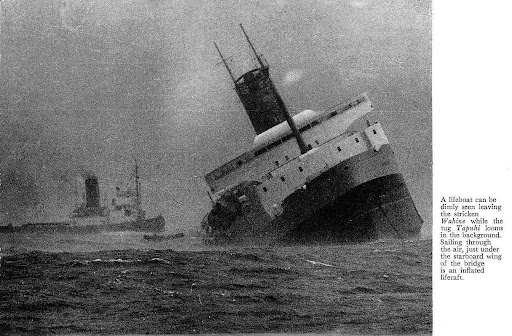
10 April 1968, with 123 officers and crew, 610 passengers and 2 stowaways on board, during on of New Zealand’s worst recorded storms, Wahine struck Barrett Reef and founded in Wellington Harbour with the loss of 51 lives.
The sinking of the Lyttelton–Wellington ferry Wahine on 10 April 1968 was New Zealand’s worst modern maritime disaster. Fifty-one people lost their lives that day, another died several weeks later, and a 53rd victim died in 1990 from injuries sustained during the sinking.
The Wahine’s demise also marked a coming of age for television news broadcasting in New Zealand, as images of the disaster were beamed into the nation’s living rooms. The footage was later screened around the world as the international media focused on Wellington.
Would-be rescuers stood helplessly on the beach at Seatoun as the Wahine succumbed to one of the worst storms recorded in New Zealand history. It seemed impossible that so many lives could be lost so close to shore. Although the main cause of the accident was the atrocious weather, a subsequent court of inquiry found that errors of judgement had been made both on board the ferry and on shore. Shipwrecks had been common in the 19th century, but this was the 1960s – how could a large, modern vessel founder within sight of New Zealand’s capital city?