
DISSTON SAW WORKS
Higgins Heritage Park gratefully acknowledges the donation of Two Disston Saws donated August 2019 by:
ERROL CHURCHMAN
50 Hunt Street, Dunedin
The medallion on this saw is from the period 1896 – 1917
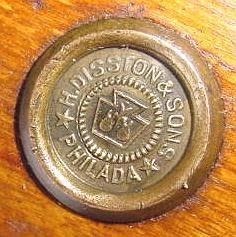
1896 – 1917


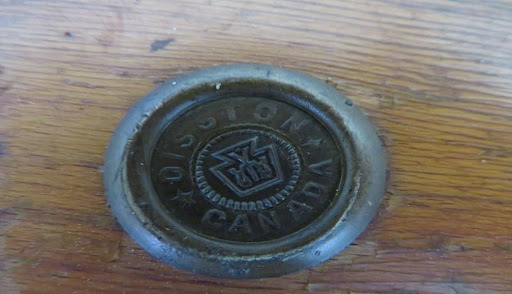
The “Disston Canada” medallion means the saw was made at Disston‘s Toronto factory (1905-1950s). Old brass medallions were used up until 1940 when steel medallions replaced the brass.
Disston made saws in Canada allowing the company to avoid a tariff on saws sold in the British Commonwealth. Brass-backed saws were more popular in England than they were in the States, so Disston made a large portion of them to sell overseas.
History
Disston Saw Works of Philadelphia was one of the better known and highly regarded manufacturers of handsaws in the United States. During the Machine Age, as Henry Disston & Sons, Inc., it was a supplier of industrial saw blades. A successor corporation, still active in Philadelphia, is called Disston Precision.
The story of handsaws in the United States mirrors the technical and political development of steel. Sheffield, England, was the center of handsaw production during the 18th century and through most of the 19th century. But England’s political and economic lock on steel making in the colonies held American saw makers at bay until well after the Revolutionary War. American steel producers could not compete until import tariffs leveled the playing field in 1861.
Henry Disston
This was the environment in which young Henry Disston (1819–1878) began his career as an American sawmaker in Philadelphia. He had emigrated from England in 1833 and started making saws and squares in 1840. In 1850, he founded the company that would become the largest sawmaker in the world: the Keystone Saw Works.
Some five years later, Disston built a furnace—perhaps the first melting plant for steel in America—and began producing the first crucible saw steel ever made in the United States. While his competitors were buying good steel from Britain, he was making his own, to his own specification, for his own needs. Disston subsequently constructed a special rolling mill exclusively for saw blades.
Over the following decade, the Disston company continued to grow, even while dedicating itself to the Union Army’s war effort. In 1865, when his son Hamilton Disston rejoined the business after serving in the Civil War, Disston changed the company’s name to Henry Disston & Son. Henry Disston and his sons set the standards for American sawmakers, both in terms of producing high-quality saws and developing innovative manufacturing techniques. Disston also started making files in 1865.
In September 1872, Henry Disston and two other men dug part of the foundation for what was to become the largest saw manufacturing facility in the world: Disston Saw Works. This was in the Tacony section of Philadelphia. Having previously moved his expanding business from near Second and Market Streets to Front and Laurel Streets, Disston sought to establish his business away from this cramped area. It took over 25 years to move the entire facility to Tacony. This Philadelphia neighborhood seems to have been the only company town in the United States established within an existing city.
Henry Disston was renowned for having one of the first industries that exhibited environmental responsibility, as well as a paternalistic view towards his employees. For example, he had thousands of homes built in Tacony for his workmen. Funds to purchase these homes were made available through a building and loan association set up by the Disston firm. Mr. Disston was ready to grant any assistance needed to see to it that his workers could purchase a home, even if advances needed to be made.
Other examples of Henry Disston’s caring influence on the community was evident in everyday life. To meet employees’ cultural needs, a hall and a library were built with Henry Disston agreeing to pay a fixed sum towards its maintenance. The Tacony Music Hall was erected in 1885, also with the assistance of Disston money.
Henry Disston had fallen ill by 1877 and never truly recovered; he suffered a stroke and died the next year. This came only one and a half years after seeing his products receive the highest honors at the great Philadelphia Centennial Exposition of 1876. His vision of a working class community and the completion of the transfer of his enormous saw plant was carried out by his wife and his sons.
Henry Disston & Sons, Inc. Philadelphia, PA
The Disston company was established in 1840 by Henry Disston as the Disston Saw Works and initially only made saws. In 1855 he cast the first crucible saw steel ever made in America. He started also making files in 1865.
This company is now known as Disston Precision Inc. and is owned by R.A.F. Industries. Their contact is 6795 State Road, Philadelphia, PA 19135 USA,
The following companies were acquired by Disston over the years:
| Johnson & Conaway – 1857 | P Fraley & Co – 1859 |
| John H Gunniss – 1861 | William Cresson – 1862 |
| Bringhurst & Verree – 1866 | James Turner – 1867 |
| Aaron Nichols – unknown | Hill & Davenport – 1868 |
| Wm & Harvey Rowland – 1870 | Waterhouse Saw Co – 1874 |
| Richardson Bros – 1890 | Harvey W Peace Co – 1890 |
| Pennsylvania Saw Co – 1892 | Wheeler, Madden & Clemson – 1893 |
| Woodrough & McParlin – 1893 | Woodrough & Clemson – 1893 |
| Baldridge & Hogan Saw Co – 1901 | American Saw Co – 1901 |
Medallions on the saw handles were a feature of the Disston saws. These changed many times over the years – a search of Google shows the large range of differences with the corresponding date periods. A few early medallion examples are shown below.
The medallion below, from an 1840’s No. 7 panel saw, reads “H. Disston. Philada”. It may not be the earliest example of a Disston medallion, but it’s close to it. It appears identical to the medallion at the top of the page, which is on a backsaw from the same period. Note the eagle’s head is pointed upward. Medallions after the 1840’s had less “
optimistic” eagles. The right medallion started appearing in 1845.

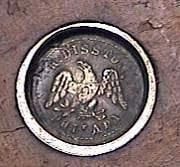
An early medallion from a backsaw, possibly late 1840’s, based on the full spelling of Henry Disston. A similar medallion, below, includes the phrase Keystone Works, which started appearing in Disston sales literature about 1850. Disston started out making only several hundred saws annually in the first years of production, increasing to perhaps 10 or 14 thousand saws per year by the end of the first decade of production. That figure is interpolation from advertising that “dozens” of saws were made each day in the factory by 1850.


Another medallion from either the late 1840’s or 1850’s. The design looks more like the 1850’s and 1860’s medallions but it uses the PHILA abbreviation. The eagle is becoming more stylized when compared to the realistic eagle design of the early 1840’s.

1860’s. Yet another variation in the early medallions. The appearance of different wings show that another die was used to make this medallion. Notice also that the pattern of dots on the perimeter is courser than the medallion above it. The Mona Lisa smile can be attributed to something marring the brass. Feel like an expert if you can narrow the age of a saw to within a decade in the field.

1865-71 One-son medallion. Split sawnuts. The company changed its name to Disston and Son in 1865, when Henry Disston’s eldest son Hamilton joined the business. He had apprenticed at the company in the late 1850’s and early 1860’s. During the Civil War he joined the Union Army against his father’s wishes. Henry Disston relented and eventually encouraged other workers to volunteer. “Ham” Disston’s war experience, volunteer work in the fire department, and hands-on work in the factory made him popular with the other employees. This particular medallion was produced for only a short time before the keystone medallion was introduced. Often saws from the mid to late 1860’s feature a Disston and Son etch on the blade and the earlier eagle medallion.

The company changed its name to Disston and Sons in 1871. When Albert Disston completed his apprenticeship at the factory in 1871, the company became Disston and Sons. Three younger brothers: Horace, William, and Jacob, eventually worked for the company as well. This medallion still featured the old-style split sawnuts that were used until about 1876. The perimeter is also sanded flush with the surface of the handle, as were all previous medallions. This changed with the introduction of the new-style saw nuts in the mid-1870’s.

Before 1876. The lettering on this medallion has serifs, unlike those before or after its production. This medallion is like the others shown above in that it is the split-nut design and is filed flush with the surface of the handle. After the mid-1870’s, the domed-style nut came into use.

This medallion is on a mid-1870’s “Choice” saw, which was introduced about 1875. The perimeter is serrated, which is unique. It is raised above the surface of the handle, the first time that feature is seen. The saw has five split nuts on the handle, which also is unique to this model.

1880’s. Larger letter “A” at the end of word “Philad’a”. One has comma after the word “sons”, the other doesn’t. Instead of sitting completely flush with the handle like earlier medallions, there is a slight radius to the perimeter of the medallion, which rises above the wood.
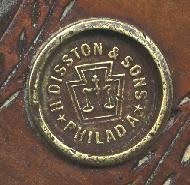
The medallion produced during the period 1896 – 1917 and is the medallion that the donated saw has.
.
Legacy
Henry Disston and Sons, Inc by the early 20th century, cast the first crucible steel in the nation from an electric furnace in 1906. The firm’s armor-plating building near Princeton Avenue and Milnor Street contributed tremendously to the World War II effort, building a volume of armor plates for steel tanks. But the company’s innovation and industriousness would not last forever. In 1955, with mounting cash-flow problems and waning interest on the family’s part to run the firm, Henry Disston and Sons was sold to the H.K. Porter Company of Pittsburgh. Porter’s Disston Division was sold in 1978 and became the Henry Disston Division of Sandvik Saw of Sweden. This division was then sold in 1984 to R.A.F. Industries of Philadelphia and became known as Disston Precision Incorporated, maker of specialized flat steel products. They have ceased making Disston handsaws, but the Disston brand name still exists in this firm.